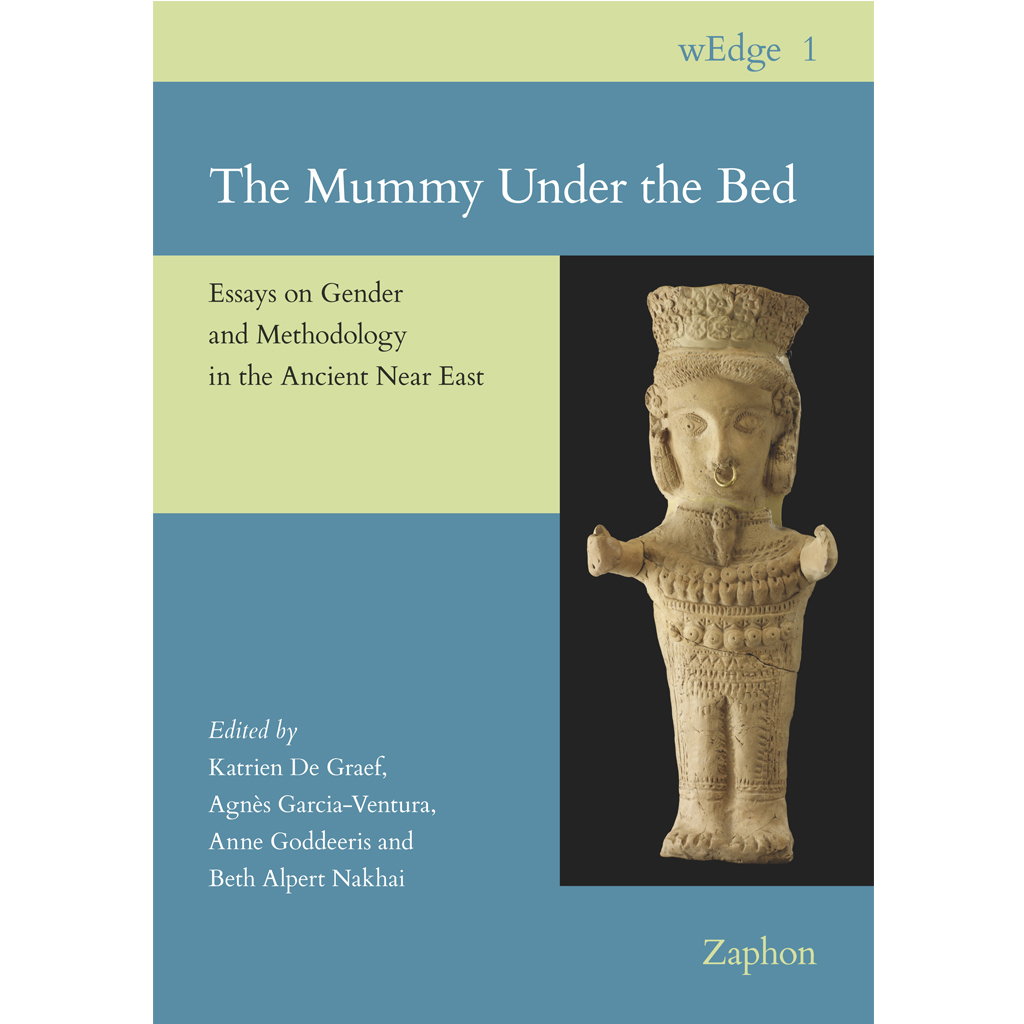
The Mummy Under the Bed
The Mummy Under the Bed. Essays on Gender and Methodology in the Ancient Near East
Edited by Katrien De Graef, Agnès Garcia-Ventura, Anne Goddeeris and Beth Alpert Nakhai
wEdge 1
2022
ISBN 978-3-96327-088-8 (book)
ISBN 978-3-96327-089-5 (e-book, via ProQuest)
455 pp. / 17 x 24 cm / hardcover, thread stitching
| Summary |
The present volume contains 17 contributions devoted to various methodological approaches to gender studies within the broad field of Ancient Near Eastern studies, including ancient history, archaeology, art history, Assyriology, Phoenician-Punic studies, and biblical studies. This collection is the result of presentations, exchanges, and discussions that took place during the “Third Workshop on Gender, Methodology, and the Ancient Near East” (GeMANE). Scholars explored new methods for addressing gender-related topics by sharing ideas, research results, and ongoing projects. Their results were further elaborated and, together with new chapters, bundled into the present volume. Building on the previous workshops, GeMANE 3 has thereby created a platform to present, examine, and discuss innovative methodological and theoretical approaches to gender within the broad framework of Ancient Near Eastern studies. Over the last several decades, gender studies has claimed its rightful place within Ancient Near Eastern studies. After the initial and sorely needed retrieval of women’s lives utilizing textual and archaeological sources, new methodological and theoretical approaches to gender and sexuality now complement descriptive studies. Going forward, GeMANE remains fully committed to opening up all possibilities inherent within (post-) feminist, masculinist, structural, queer, and related theories. Also fundamental are innovative (digital) methodologies for historical, art historical, archaeological, and philological subjects within Ancient Near Eastern studies. The content of this volume is structured in four thematic sections. The first section, “Reading Against the Grain,” is devoted to studies in which dominant readings of both textual and archaeological sources are questioned and alternative, resistant readings are offered. The second section, “Cult and Cults,” contains contributions on the role of women and feminine identity in cult, and on (en)gendered spaces in religion and mythology. The third section, “Ancient Beauties,” includes chapters on divine fragrance, beautification practices, bodily adornment, and binary gender stereotypes. The fourth section, “Networks and Powers,” contains contributions on the role of women and female networks in economy and society, and on the application of Social Network Analysis. But first and foremost, the introductory chapter is devoted to the memory of women in Ancient Near Eastern studies. |
|---|---|
| Table of Contents |
Preface and Acknowledgements: Some Words with a Mummy Agnès Garcia-Ventura: Women Talking about Women: Excavating the Memory of Women in Ancient Near Eastern Studies
1. Reading Against the Grain Frances Pinnock: The Late Bronze Age in Syria: Was It a Dark Age for Women? Ann K. Guinan: The Female Gaze: The Subjected Body in Tablet 103 of Šumma ālu Omens 1–7 Katrien De Graef: In nomine matris et filii . . . The Use of Matronymics in the Legal and Economic Documents from Sukkalmaḫ Susa
2. Cult and Cults Natalie Naomi May: Women in Cult in First Millennium BCE Mesopotamia Lorenzo Verderame: Engendered Cosmic Regions in Ancient Mesopotamian Mythologies Karolien Vermeulen: Of Cities, Mothers, and Homes: A Cognitive-Stylistic Approach to Gendered Space in the Hebrew Bible Elizabeth B. Tracy: Vanishing Point: New Perspectivity on Women in the Book of Exodus
3. Ancient Beauties Anne Katrine de Hemmer Gudme: The Aroma of Majesty: Gender and the Hebrew Bible’s Olfactory Cultic Theology Meritxell Ferrer / Mireia López-Bertran: Performing Beauty in Phoenician-Punic Cultures: A Gender Perspective Letteria Grazia Fassari / Raffaella Frascarelli: Embodying the Past: The Case of the Goddess on Lion at Hasanlu Sera Yelözer / Mihriban Özbaşaran: Entangled at Death: Beads, Gender, and Life Cycles during the Central Anatolian Early Neolithic; Aşıklı Höyük as a Case Study
4. Networks and Powers Baptiste Fiette: Zinu, Wife and Manager in Old Babylonian Larsa Brigitte Lion: Grandmother’s Tablets: Some Reflections on Female Landowners in Nuzi Anne Goddeeris: Women and Their Weight: Incorporating Weighted Edges in a Network Analysis of the Central Redistributive Household of Nippur (Eighteenth Century BCE) Allison Thomason: Women’s Property and Social Networks in Mesopotamia Ilan Peled: Was It Law? Gender Relations and Legal Practice in the Ancient Near East
Index |