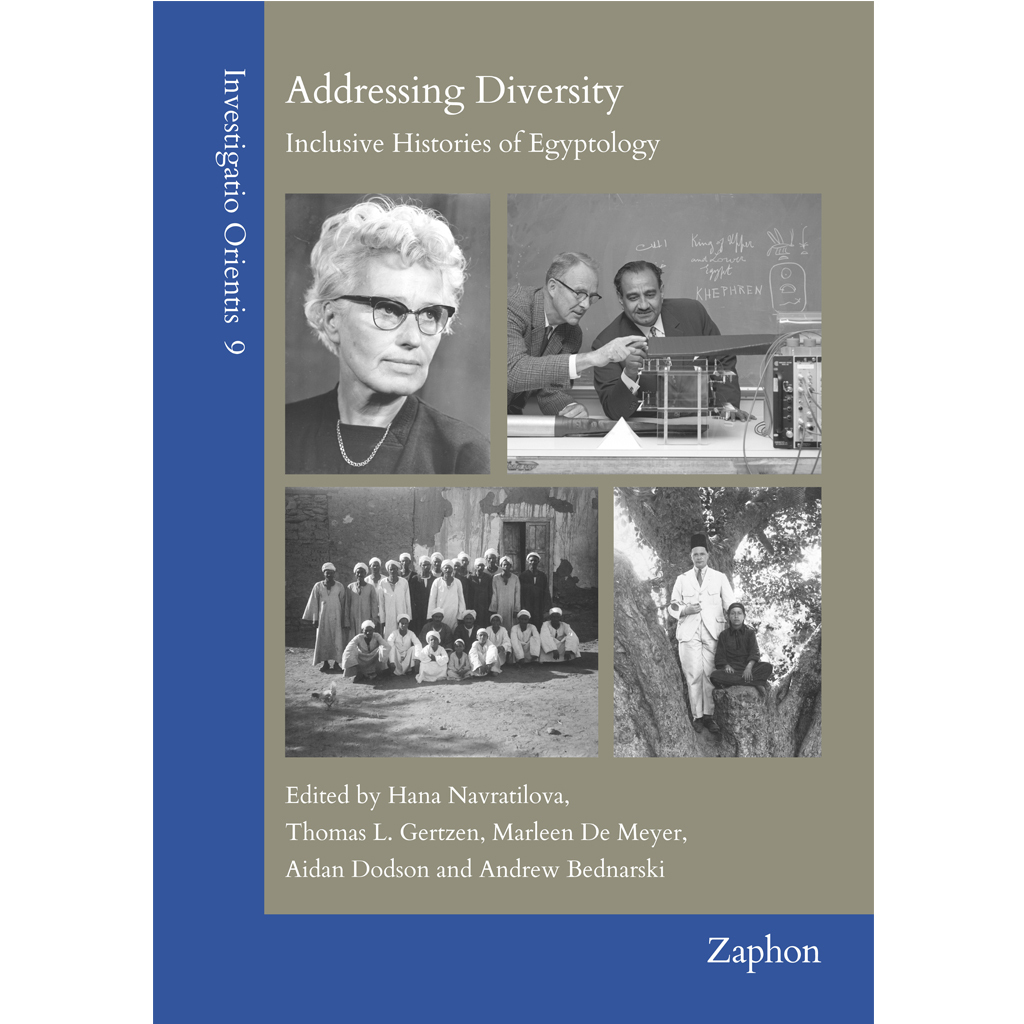
Addressing Diversity New
Addressing Diversity. Inclusive Histories of Egyptology
Edited by Hana Navratilova, Thomas L. Gertzen, Marleen De Meyer, Aidan Dodson and Andrew Bednarski
Investigatio Orientis 9
2023
598 pp.
17 x 24 cm / hardcover, thread stitching
ISBN 978-3-96327-144-1 (book)
ISBN 978-3-96327-145-8 (e-book, via ProQuest)
| Summary |
The volume is dedicated to the ‘supporting characters’ in the history of Egyptology who are not often in the limelight. This is not intended to work to the detriment of the lead actors, nor is the intention to politicize disciplinary history. Rather, it is meant as an appreciation and recognition of the range of agents involved, and relationships within their networks. Rendering disciplinary history more inclusive is a long process. The case-studies assembled in this volume do not aspire to represent the complete range of possible stakeholders. Instead, it is intended to open-out the discourse, and to demonstrate various modes in which individuals have advanced research into ancient Egypt. To cite but two ‘marginalized’ groups, women have often been presented as subservient spirits, assisting their Egyptologist-husbands, with perhaps the concession that ‘behind every great man there has to be a great woman’. For a long time all-but-excluded from academia, such individuals’ contributions have been disregarded. Second, exclusion from academia was also the fate of most early Egyptian Egyptologists. Within the frame of post-colonial studies, they have only recently garnered serious attention. Yet, even then, the paradigm of ‘Western’ disciplinary history has been replicated, concentrating on the outstanding figures and lead players in the field, often to the detriment of lesser-known scholars, officials, and local actors such as the Quftis and workmen. This volume is thus not meant to criticise previous endeavours in the recent development of disciplinary history but, rather, as a constructive contribution or complement to these. We cannot make amends for past implicit slights, or restore a person’s role in the history of Egyptology to its ‘rightful place’, but the aim is to broaden the perspective of the history of Egyptology, while at the same time paying more attention to its diversity. |
|---|---|
| Table of Contents |
Editors’ Foreword: From ‘Giants’ to addressing diversity
Pioneers & Polymaths Andreas Alm: Valdemar Schmidt and the foundation of Egyptology in Denmark Wolf B. Oerter: Wien – Prag – Wien – Philadelphia: Nathaniel Julius Reich (1876–1943), der rastlose Wanderer Isolde Lehnert: An independent scholar and collector: Ludwig Keimer in Egypt Vincent Oeters: Frans Jonckheere: A Proactive Pioneer in the Study of Ancient Egyptian Medicine Thomas L. Gertzen: ‘Not the button on Fortuna’s cap’: The Egyptologist and Celtologist Ludwig Julius Christian Stern (1846–1911)
The female perspective Hélène Virenque: Hermine Hartleben: Une vie et une œuvre au service de l’égyptologie allemande et française Nicky Van de Beek: Braving the odds: Egyptologist Herta Mohr during the Second World War Peter Dils: Dr. Hildegard von Deines (1902–1978): Ägyptologin im zweiten Leben
The Egyptian perspective Nora Shalaby, Ayman Damarany & Jessica Kaiser: A Nazir and an Effendi: Glimpses from the Abydos Paper Archive Mostafa I. Tolba: On the Trail of Ahmed Fakhry: The Legacy of an Egyptian Archaeologist Ladislav Bareš: Sixty years of the el-Kereti family at Abusir Felix Relats Montserrat: Les ouvriers de Médamoud: Le fonctionnement d’un chantier français en Égypte au début du XXe siècle Marleen De Meyer, Wouter Claes, Noha M.A. Mahran, Athena Van der Perre, Aude Grâzer Ohara: Working with Capart: Quftis and local workmen during the Elkab excavation seasons, 1937–1946
Individuals and Encounters Rosalind Janssen: Anthropometry beyond UCL: Measuring the Egyptian Fellahin, c. 1900 Heike C. Schmidt: The ‘little Brugsch’: The life and adventures of Emile Brugsch Bart R. Hellinckx: Fritz Krebs (1867–1900): Forgotten école de Berlin Egyptologist and pioneer papyrologist Wendy Doyon: Xia Nai’s Egypt in the Archaeology of China: Field Workers and Field Methods in Xia Nai’s Diary at Armant, Egypt, 1938 Thais Rocha da Silva: Ancient Egypt in Africa: Why it matters to Brazilian Egyptology Alexandre Loktionov: From class foes to the upper class: Diverse paths to fame and fortune in Soviet Egyptology
Illustration Credits Index |